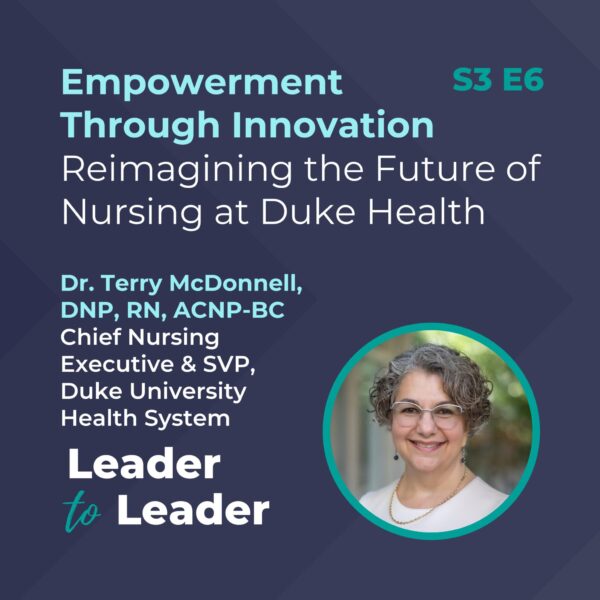
Empowerment Through Innovation: Reimagining the Future of Nursing at Duke Health
As healthcare embraces new delivery models, the role of the nurse is evolving beyond traditional bedside care. In this episode, Dr. Terry McDonnell of Duke Health discusses the evolution of the profession and the reshaping of the nursing workforce.
Follow and subscribe on



Listen to the Podcast
Overview
The pandemic fundamentally reshaped the nursing workforce, creating both challenges and opportunities to reimagine care delivery.
In this episode, Dr. Terry McDonnell, Chief Nursing Executive and Senior Vice President at Duke University Health System, discusses how Duke Health is addressing turnover in nursing, empowering frontline staff through innovation initiatives, and building robust career pipelines as early as eighth grade.
With a goal of building a sustainable, future-focused nursing workforce, Dr. McDonnell offers valuable insights into creating technology-enhanced innovation units, leveraging AI and ambient technology to transform documentation, and adapting care models for the next generation of patients.
In this episode, you’ll learn:
- How Duke Health is addressing the post-pandemic nursing challenge with empowerment initiatives that reduced turnover by 10%
- The role of AI and technology in building the care environments of the future
- Why Dr. McDonnell believes the future of nursing will be hybrid, creating a need for nurses skilled in both direct and virtual patient care

Our Guest
Terry McDonnell, DNP, RN, ACNP-BC
Terry McDonnell, DNP, RN, ACNP-BC is the Chief Nursing Executive and Senior Vice President at Duke University Health System, Vice Dean for Clinical Affairs at the Duke University School of Nursing, and Watts College of Nursing, Board Chair. In her leadership role, she collaborates with Chief Nursing Officers and system leaders to foster a culture of belonging and purpose among frontline clinical teams, ensuring that patients and their families receive exceptional, patient-centered care. She continues to work as a Gastrointestinal Oncology Nurse Practitioner at Duke Cancer Institute.
Previously, McDonnell served as Vice President of Clinical Operations and Chief Nursing Officer at Fred Hutchinson Cancer Center in Seattle, where she oversaw clinical operations and professional staff, enhancing the delivery of high-quality, patient-focused services. Her leadership and management skills were instrumental in the success of the center’s operations. An acute care-certified nurse practitioner, she specializes in gastrointestinal cancers and is a Clinical Associate of Medicine at the University of Washington. McDonnell has also contributed as a clinical preceptor at Harvard Medical School and the MGH Institute of Health Professions.
Recognized for her empowering leadership style, McDonnell excels in developing high-performing teams through collaboration and engagement. Her commitment to compassionate care has earned her several accolades, including the National Pancreas Foundation Compassionate Caregiver Award.
McDonnell holds undergraduate degrees in English and Economics from Boston College, a Master’s in Acute Care Nursing, and a Doctor of Nursing Practice in Administration from the MGH Institute of Health Professions.
Transcript
This has been generated by AI and optimized by a human.
[00:00:00] Terry McDonnell: I think the nurse of the future and the future, as I said, is within this one to five year trajectory, is that we are going to be training nurses to provide care direct with the patient, but also virtually, and that’s a whole new skillset. So it’s teaching to the technology, but it’s also teaching too.
[00:00:22] Terry McDonnell: Really being able to educate, understand what sick sounds like, what sick looks like when we’re in this kind of an environment rather than with the patient. Hands on.
[00:00:36] Narrator: From Healthcare IT leaders, you’re listening to Leader to Leader with Ben Hilmes.
[00:00:41] Narrator: Our guest today is Dr.
[00:00:43] Narrator: McDonnell, chief Nursing Executive and senior Vice President at Duke University Health System.
[00:00:48] Narrator: Terry shares how the pandemic reshaped the nursing workforce and why now is a pivotal moment to reimagine how care is delivered.
[00:00:58] Narrator: She breaks down the real challenges around nurse turnover, the importance of on the ground support, and how Duke is empowering staff to lead innovation.
[00:01:07] Ben Hilmes: Dr. McDonnell, it’s wonderful having you on the podcast. I’ve been looking forward to this one for some time. I’ve, I’ve been on record many times talking about how much of a fan I am of nurses. I come from a family of nurses, grandmother, brother, uh, lots of friends. My daughter wants to go into nursing, so it’s kind of one of those things that, you know, I have a passion for and, and a lot of it’s because I think. most nurses I’ve met are very mission-driven and they get stuff done, and I like getting stuff done. So this is gonna be fun. So we’re gonna talk about the current state of nursing. We’re gonna talk about some of the workforce challenges, and then I’d like to pivot and talk about innovation and how we’re leveraging some of the new, new innovation to help address some of those challenges. And so I wanna start by.
[00:01:56] Ben Hilmes: Kinda rewinding a little bit to the pandemic. it’s had an incredibly enduring impact on healthcare and nursing in
[00:02:00] Ben Hilmes: particular. I feel like it’s really reshaped the workforce of nursing. So I’d love to hear your perspective on some of those impacts. and how are you feeling about the ripple effects of it all and how does it look today?
[00:02:13] Terry McDonnell: Well, that’s a loaded question. let me give you my perspective on kind of the trajectory of what the pandemic created. You know, at the beginning it was this mobilizing force brought everyone together. We had something to, to fight against and it was a period of rapid change, rapid decision making.
[00:02:34] Terry McDonnell: there was feel good at the beginning, as odd as it sounds. And then during the height of it. the impact of just the prolonged intensity of it all. And that’s when we started to see those images of people breaking down. And then as we started to get to kind of that, that normalcy of it all of the chaos, that’s when we saw the unwinding.
[00:03:00] Terry McDonnell: We saw people leaving the profession dissatisfaction, the great resignation, and then we started to come out of it and we started to normalize. But to your point, the workforce has changed.
[00:03:13] Terry McDonnell: A lot of the senior staff have transitioned out of their, their bedside roles, and we have a new workforce that has a lot of energy, but they’re young.
[00:03:26] Terry McDonnell: That’s nurses as well as our, physician colleagues. And I think we are at a crossroads right now where we are dealing with a lot, we’re trying to rebuild the workforce, we’re trying to deal with pivoting to all of the changes that are coming with the changes in payer paradigms and federal regulation and all of those things.
[00:03:54] Terry McDonnell: What I want to see is I would love to see nursing lead and think about how we can change models of care and do things differently and not fall back into that same trajectory we fell into during the pandemic.
[00:04:10] Ben Hilmes: I love it. I, I mean, one that was a loaded answer, which is really good. That gives a lot to talk about. and, you know, before we started, you were, you were talking about the amount of change that was. able to occur in a short period of time relative to the pandemic and that, taking advantage of a crisis to fundamentally drive change.
[00:04:30] Ben Hilmes: And so that feels like, uh. What you’re doing. I’d love for you to go a little deeper. You know, you talked about, turnover’s still too high. Lots of nurses are actually switching employers. They’re getting out of the profession entirely. What are you doing at, Duke Health to, to kind of stem that and, how are you rethinking how you engage with nurses, retain them, recruit them, all of those things?
[00:04:55] Ben Hilmes: Because, uh, to do all the things you just said is gonna take a lot of work.
[00:04:59] Terry McDonnell: it does take a lot of work and I think we’re, we’re tackling it from a bunch of different perspectives. So in 2022, our turnover was 25%. For RNs, we’re now down to the industry standard around 14.9%. When we looked at all of the, the data, the reasons why it was about engagement, feeling like they were supported when they joined the workforce, a big chunk of that turnover has been happening in the first three years of a nurse’s tenure.
[00:05:35] Terry McDonnell: New to the profession. So that gave very strong signals to us that we were missing the mark as people were joining the workforce and as many systems did pre pandemic, we went to these central education models, a lot of online, lot of central onboarding, and we pivoted away from. Elbow support and unit-based education or clinic-based education, and we’ve just completed a year long transformation in bringing all of that resource back to the elbow of the nurse.
[00:06:15] Terry McDonnell: So as we’ve got new devices, new protocols, we’ve got educators right there at the elbow helping our staff feel comfortable and competent. So that’s one lever.
[00:06:27] Terry McDonnell: I think another piece that we heard loud and clear was a lack of empowerment. Feeling of things being imposed upon rather than having a voice in.
[00:06:37] Terry McDonnell: And what we know is that the people who are doing the work often see the problems in a much different way than we do sitting in the seats that we are in They’ve got the answers. They know the solutions. They can see it so clearly. So we’ve launched a number of initiatives. One is called Empowerment Through Innovations.
[00:06:57] Terry McDonnell: We created a QR code that any frontline staff member can, pick up on their phone, brings them to four simple questions. What’s the problem? What have you done? what’s your solution and how can we help? We’ve gotten some great ideas. Some, some just do it things and other projects that are gonna be bigger, that are gonna require a little more energy.
[00:07:20] Terry McDonnell: But we’re engaging the workforce in how to solve the problems.
[00:07:24] Terry McDonnell: the third lever, is really creating a pipeline and engaging the community. We’re really spoiled here at Duke. we’ve got not only the Duke University School of Nursing, But we also have the Watts College of Nursing that’s part of the health system, and Watts, the oldest nursing school in North Carolina.
[00:07:46] Terry McDonnell: And so we get to have these wonderful, fertile training grounds embedded right in our health system. We also have very strong partnerships with the Durham Public Schools and some of our technical community colleges. You may have heard, about the Bloomberg Foundation providing, training grants across the country.
[00:08:08] Terry McDonnell: We were recipients of one of those grants, and what we’re doing is we’re establishing a early college high school program, so kids who are in the eighth grade who have an interest in maybe pursuing healthcare can go to this early college high school. The first class starts in September and they can choose a pathway into nursing.
[00:08:29] Terry McDonnell: They can choose a pathway into being a medical assistant, surgical tech, or going into clinical research. And at the end of four and a half years, they come out with a certification and we can hire them into the health system and they train in our health system.
[00:08:44] Ben Hilmes: That’s fantastic. I like that you’re, you’re not just setting it and forgetting it, right. You’re, you’re engaging often. That’s really, really important. I think. you’re doing change. It’s inevitable, but you’re doing it with them and you’re asking for them to engage in, in all of that. And then I. duke in many ways, uh, to the general population is known for their athletics, and they’ve done a tremendous job of probably recruiting in grade school.
[00:09:08] Ben Hilmes: It feels like maybe you’ve taken a little bit of that, that strategy to say, how do we go upstream or in this
[00:09:14] Ben Hilmes: case downstream, to, you know, a younger population and, and so that’s just wonderful to start building that pipeline of new nurses as early as eighth grade. I know my daughter is, uh. she’ll be a junior next year, and she’s been able to take some of those kinds of, curriculum courses that align to the, you know, the future profession.
[00:09:34] Ben Hilmes: I, I didn’t have that luxury when I was going through high school, so I think it’s wonderful that we’re, we’re engaging them early. that’s just great.
[00:09:48] Ben Hilmes: So let me pivot to a little bit of technology here. So it’s obviously a younger generation and, tech, it’s really not technology to them, it’s just something they do. but it certainly plays a role here and I’d love to see, you know, how you’re leveraging, a lot of people talk about ai. I’d love your opinion on how that’s influencing on the positive side and maybe even in the not so positive way. And then, you know, what other programs and new technologies are you using there at Duke? to help kind of curb? The challenge?
[00:10:14] Terry McDonnell: we’ve been using ai. For several years. I think a lot of us, and I’ll include myself in that, we were just blissfully unaware. Now though, it’s here. It’s happening and you know, I think we have an opportunity, the way we do our work is materially going to change in the next two to five years.
[00:10:39] Terry McDonnell: And one big, thing that I think a lot of health systems are starting to implement is this ambient voice recognition technology. So getting rid of pajama time for, for providers. And I happen to be a nurse practitioner, so I fall into that category, but for the bedside nurse, it’s walking into the patient’s room with your device and being able to audibly record.
[00:11:06] Terry McDonnell: What you’re seeing, what you’re observing. All the activities that then get loaded into the chart. We’re far more advanced, I would say, with the ambient documentation for providers, for clinicians than we are for the bedside nurse. There’s a couple of big players in the market right now that are trying rapid development to get us to that optimal state where we can start really getting out of the pilot phase.
[00:11:34] Terry McDonnell: Deploying, the nursing components of these ambient technologies broadly. So that’s coming on the horizon. but some of the other things that are really exciting and very compelling are how we’re going to construct and build hospital rooms and clinic rooms of the future.
[00:11:52] Terry McDonnell: So here at Duke, we’re in the process of building out three, what we call innovation units.
[00:11:57] Terry McDonnell: So we took three floors of med-surg units that were due for rehabilitation, and we are partnering with a couple of key industry partners to fully outfit them. And what I mean by fully outfitting them is with electronic whiteboards, with computer vision technology to help us with things like monitoring for falls.
[00:12:21] Terry McDonnell: Monitoring for movement to reduce pressure injuries, all of this then is gonna be loaded. All of this capability will be loaded in the care environment of the future. And then imagine a world where we can accelerate. Our learning and also accelerate our care. So rather than reacting to a bed alarm or reacting to a pressure injury, we can go far upstream and mitigate these things from ever happening.
[00:12:54] Terry McDonnell: And the goal is to improve outcomes, reduce harm, and give a much better, safer patient experience. I think the other thing we have the opportunity to do as well is that we can also change the paradigm of what it means to be, a clinical nursing provider. And I use those words very, very carefully because right now, you know, the typical new grad goes into either a clinic setting or a hospital setting where they’re quote at the bedside.
[00:13:31] Terry McDonnell: I think the nurse of the future and the future, as I said, is within this one to five year trajectory, is that we are going to be training nurses to provide care direct with the patient, but also virtually, and that’s a whole new skillset. So it’s teaching to the technology, but it’s also teaching too.
[00:13:54] Terry McDonnell: Really being able to educate, understand what sick sounds like, what sick looks like when we’re in this kind of an environment rather than with the patient. Hands on. So this would be a whole new skillset. And I think the rest of the future will spend, you know, part of their time, direct patient care, part of it virtually, or even with device monitoring, looking at advanced analytics and making, clinical, education, recommendations to the patient.
[00:14:24] Ben Hilmes: that’s really, really cool stuff though. Uh, you know, if you think about it, industries when they become digitized can be then be transformed. And what you’re talking about here is, you know, we went through the meaningful use era where we digitized the EMR, now we’re leveraging ai, which. Although feels new. We’ve been using AI for some time,
[00:14:45] Ben Hilmes: like you said. and then three is some of these advanced technologies with sensors and motion studies and all of those things. and you guys have committed three floors of your insti. That’s more than a pilot. So you guys are, you’re literally committed.
[00:14:58] Ben Hilmes: I would
[00:14:58] Ben Hilmes: love to. Continue to see that advance. And how do we learn more about the outcomes, or, I assume you’re sharing those on different platforms and, how would our audience get some insights into how that’s playing out?
[00:15:12] Terry McDonnell: the three innovation units open in October and we’ve partnered with, our schools of nursing, engineering, and business. And our goal is to disseminate our learnings broadly. Through publishing, through conversations like this, through presentation, for GCEs, you know, anybody who wants to come and observe and learn, we will invite people, you know, and again, all carefully vetted, but there’s no better way of really seeing how this can transform care than coming and seeing and experiencing.
[00:15:45] Ben Hilmes: That’s awesome. Well, I may, I may take you up on that personally. so I’ll be reaching out. you mentioned tele and virtual. We saw the pendulum swing heavy during the pandemic, and then shockingly, I think we saw it go back the other way a little more aggressively than we anticipated. But it feels like you’re pulling it back, and you’re leveraging technology.
[00:16:06] Ben Hilmes: You’re
[00:16:06] Ben Hilmes: leveraging new ways to work. tell me about, you know, how you want to. How you see that playing out and, is it gonna help pull the pendulum back over to virtual and, and tele?
[00:16:17] Terry McDonnell: I think it’s all going to be hybrid.
[00:16:20] Ben Hilmes: Okay.
[00:16:21] Terry McDonnell: think it’s gonna be comprehensive. The right model, I believe is, you know, making sure that we deliver the right care for the right condition in the right setting. I. A lot of this is gonna be driven by our patients. we’ve got generations of people now that are coming into the workforce that are consumers of healthcare, they actually have not been brought up having a conversation at the dinner table.
[00:16:48] Terry McDonnell: Their communication is primarily with text,
[00:16:53] Terry McDonnell: quick videos, quick bites of information. We need to meet the needs of that patient population as much as we need to meet the needs of an aging baby boomer population. So I really think it is going to be a, a, a hybrid.
[00:17:07] Ben Hilmes:
[00:17:07] Ben Hilmes: It’s interesting you have a annual nursing innovation summit. Talk to me about what that’s all about.
[00:17:15] Ben Hilmes: what are some recent ideas that came out of that? What are you looking to accomplish this year?
[00:17:19] Terry McDonnell: So getting back to that empowerment piece. it’s a hackathon format.
[00:17:25] Ben Hilmes: Huh?
[00:17:26] Terry McDonnell: a call out to our, our nursing staff, of which we’ve got around 9,500 and we’ll give a theme. So this past, nursing innovation summit that we had in the spring was around harms reduction, reducing falls. Line, infection, pressure, injury, and we said, bring us your solutions.
[00:17:51] Terry McDonnell: And we get them together. we allow them kind of that forming period of time with some facilitation, and then at the end of it, they do their pitches and they do their pitches to a panel of judges. Our chief nurse informatics officer, our chief Nurse innovation officer, a representative from the School of Engineering and one of our nursing leaders, and this panel scores the presentations, and then we fund the work.
[00:18:20] Terry McDonnell: So one of the ideas, and, anything that’s low hanging fruit, just do it. We just do it.
[00:18:26] Ben Hilmes: And we had some great concepts come out of this last one. One was around reducing line infections for central lines. And, the group of nurses, this little team thought, what if we could introduce blue light technology into those clay connectors where the IV tubing attaches to the central line?
[00:18:50] Terry McDonnell: Because anywhere there’s a connector, that’s your greatest risk for introducing bacteria. So again, we’ve got people working on that concept. Is that something that we could do? And then that would be something that would keep, would be mass produced. You know, in the past we’ve had other projects that have come up.
[00:19:12] Terry McDonnell: One was around, virtual reality training. So there was a team of nurses who wanted to. Increase the skillset for nurses to reduce workplace violence incidents.
[00:19:26] Ben Hilmes: Wow.
[00:19:27] Terry McDonnell: So we give patients a lot of medications. We put them in conditions where they can become confused and sometimes they can become combative,
[00:19:36] Ben Hilmes: Sure.
[00:19:37] Terry McDonnell: and you don’t train for that when you’re in nursing school.
[00:19:41] Terry McDonnell: So we wanted to give our new nurses the ability to train and to respond in a safe way, but that we can run different dynamic scenarios with them.
[00:19:54] Ben Hilmes: in my own mind, I think Sure. That all makes sense. But you’re right. I mean, I doubt there’s a course in nursing school that. Focuses on that.
[00:20:01] Ben Hilmes: so that’s really, really neat. And it’s interesting that you, you kinda lean into that, you embrace it then, then you action some of the ideas coming out of this summit.
[00:20:09] Ben Hilmes: you’re obviously a change agent and part of these, shows. I love to kinda land on your leadership journey.
[00:20:21] Ben Hilmes: So how did you get into nursing? you then obviously have, you know, risen through the ranks and moved into nursing leadership. You, have gone all the way in school and done some amazing things, throughout your career, but I’d love for you to share with me that journey.
[00:20:36] Terry McDonnell: it’s a little bit of a twisted path.
[00:20:39] Ben Hilmes: They always are, aren’t they? That’s great.
[00:20:43] Terry McDonnell: so I mean, I grew up, the kid of a chef and an artist
[00:20:49] Terry McDonnell: who owned a flower shop when I was young. And my degrees, my undergraduate degrees are in English and economics from Boston College. I had a couple of careers before ever getting into nursing. we owned a family, restaurant, so I was, the pastry chef
[00:21:07] Ben Hilmes: Oh,
[00:21:08] Terry McDonnell: had never done anything in the, in a formal kitchen.
[00:21:13] Terry McDonnell: And I can distinctly remember saying to my dad, who’s gonna be the pastry chef? We need to hire somebody. He said, oh, no, that would be you.
[00:21:20] Terry McDonnell: this is the late nineties. There was no YouTube, there were barely any cooking shows. So I, you know, cookbooks and I, and I taught myself.
[00:21:29] Ben Hilmes: That’s wonderful.
[00:21:30] Terry McDonnell: but you know, life takes you down some different paths.
[00:21:32] Terry McDonnell: And we had a couple of pretty extreme family illnesses that I was, front and center for. And, you know, after my father’s death, he died of interstitial pneumonitis after nine 11. I looked at my husband and I said, you know, I think I’m meant to do something different. At the time I was running a Montessori school, which by the way, I I still use those skills,
[00:21:55] Ben Hilmes: That’s great.
[00:21:56] Terry McDonnell: and uh, it was 2002.
[00:22:01] Terry McDonnell: I started taking my prerequisites in January. By September, I was fully matriculated to the Mass General Institute of Health Professions Program, and I never looked back. I made my way through the ranks. I worked as a nursing assistant, nurse practitioner. I’ve taken care of oncology, uh, GI oncology patients for the last 20 years.
[00:22:19] Terry McDonnell: Proudly, I still see patients and leadership. It was interesting, you know, in healthcare, if you’re willing to raise your hand and you’re willing to take on a project or participate in something. It opens doors for you, and I was always the one who wanted to think differently, try something new. I would take on the project.
[00:22:43] Terry McDonnell: I was also a little, a little bit older and a little more mature, and here I am.
[00:22:48] Ben Hilmes: That’s great. I, I mean, the constant curiosity I think is, is important. And never lose that. Never stop learning, never
[00:22:56] Ben Hilmes: stop challenging yourself. And, um, I love your path. That’s really, that’s really neat to see. You know how you get there. At some point you end up with a, deep rooted why.
[00:23:09] Ben Hilmes: You have that in, in spades and, I am confident that you have so many of your nurses across your organization that, admire you in so many ways and just a wonderful organization you’re running and, and I can’t thank you enough for coming on the podcast and sharing your insights, perspectives. again, I’ll kind of end where I started, which is I love this profession. I love the people in it and I just don’t think healthcare works. It can’t work without nurses. you know, anything we can do to support them, advance them, I’m all in. So this has been wonderful. I really appreciate your time and, thanks for joining.
[00:23:45] Terry McDonnell: Thank you so much, Ben. It’s been such a pleasure. Thank you for all that you do.
[00:23:50] Ben Hilmes: Terry is doing incredible work at Duke Health. During our conversation, she shared thoughtful stories about the future of nursing and the changing landscape of care delivery. Here are a few highlights. First, the pandemic left a lasting impact on the nursing workforce. Many nurses retired early and burnout hit newer nurses.
[00:24:08] Ben Hilmes: Very hard. It’s pushed leaders to rethink how they support new nurses for the long haul. Second,
[00:24:14] Ben Hilmes: duke Health is building the future of care with intention. They’re using tools like ambient voice tech, and AI powered monitoring. They’ve also created innovation units that test ways to improve patient outcomes, reduce harm, and blend in-person, and virtual care for more flexible nursing models.
[00:24:31] Ben Hilmes: Third, Terry believes in empowering people. She gives nurses the chance to lead by creating spaces for them to share ideas.
[00:24:39] Ben Hilmes: That includes tools like QR code submissions and events like the Nursing Innovation Summit, where frontline staff are encouraged to dream big and drive change. What stood out to you from Terry’s story? We’d love to hear your thoughts.
[00:24:51] Ben Hilmes: Connect with us on social or@healthcareitleaders.com. Thanks for joining us for Leader to Leader. To learn more about how to fuel your own personal leadership journey through the healthcare industry, visit healthcareitleaders-dot-com. Don’t forget to subscribe so you don’t miss any insights and we’ll see you on the next episode.