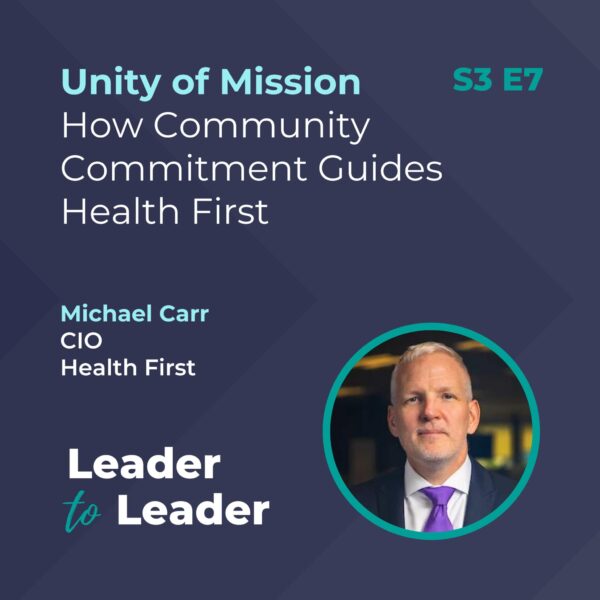
Unity of Mission: How Community Commitment Guides Health First
In this episode, Health First CIO Michael Carr discusses how a strong community mission anchored his organization through significant leadership changes and an Epic implementation. He shares insights on partnering with competitors to serve Brevard County, adopting a fast-follower AI strategy focused on reducing clinician burnout, and applying military leadership lessons to healthcare transformation.
Follow and subscribe on



Listen to the Podcast
Overview
How do you lead through change and uncertainty? Start with your mission and let it guide the way.
For Michael Carr, Chief Information Officer at Health First, that clarity of purpose has kept the organization steady through leadership turnover, provider shortages, and a system-wide Epic implementation. In this episode, he shares how Health First’s community-first approach impacts their AI strategy and technological investments.
In this episode, you’ll learn:
- How to lead through turnover and organizational change
- What innovation means in leadership
- How to apply AI in ways that support human care
Our Guest
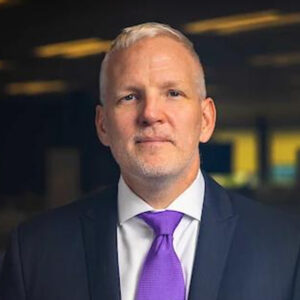
Michael Carr
Michael Carr serves as Chief Information Officer at Health First, an integrated delivery network in Brevard County, Florida, with four hospitals, a 500-provider medical group, and a health plan serving 115,000 members. Since joining Health First in 2020, Michael has led the organization through significant technology transformation, including serving as VP, CTO/CISO before being promoted to CIO in 2023. Under his leadership, Health First successfully implemented Epic across their provider network in June 2024, with health plan implementation following later that year. He is a Certified Healthcare CIO (CHCIO) through CHIME.
Before joining Health First, Michael spent over 13 years in senior IT leadership roles at Legacy Health and Providence Health & Services in the Pacific Northwest. At Providence, a five-state healthcare system with 34 hospitals and 76,000 employees, he served as AVP of IT Infrastructure & Operations and COO of Information Services, leading teams of over 300 IS professionals and executing enterprise-wide technology strategies. Michael began his career as a Finance Manager at UPS after serving as an Airborne Ranger in the U.S. Army. His leadership philosophy is deeply influenced by his military background, emphasizing unity of mission, innovation under pressure, and empowering teams to solve complex problems.
Transcript
This has been generated by AI and optimized by a human.
[00:00:00] Michael Carr: What helps us is when you have a strong mission-driven organization, you really know who your values are, why you’re here at Health First. We’re committed to the Space Coast community, and so that’s one of the things that’s helped ground people regardless of all the turnover and the change. Our mission about providing for the care of this community is what keeps people grounded. So I think when you have a strong mission, it helps.
[00:00:18] Voice Over: From Healthcare IT Leaders, you’re listening to Leader To Leader with Ben Hilmes. Our guest today is Michael Carr, Chief Information Officer at Health First, an integrated delivery network based in Brevard County, Florida. In this conversation, Michael discusses Health First’s growth strategy, their Epic implementation, and how they’re leveraging AI to support clinicians and improve patient care—all while staying focused on their community mission. He also shares insights on navigating leadership changes and addressing healthcare provider shortages.
[00:00:50] Ben Hilmes: Michael, hey, it’s great to have you on the show. I want to start by just thanking you for your service. I recognize you’re a former Army Airborne Ranger, a very elite group of individuals. So one, thank you for your service, and I actually want to come back to that at the very end. I want to understand a little bit about how that’s influenced you as a leader over time. But hey, we’ve got a lot to talk about today. Maybe just to get things started—you’re at Health First. I’d love to have you share a little bit about who is Health First, and then just broadly kind of who you serve and what you guys got going on.
[00:01:27] Michael Carr: Sure. Well, thanks for having me, Ben. And yeah, Health First—we’re an integrated delivery network based in Brevard County, Florida. We call ourselves the Space Coast, so I always tell people we’re east of Orlando. Think Cocoa Beach, Cape Canaveral—we’re there, south. So we have four hospitals. We have about a 500-provider medical group, and then we have a health plan that serves about 115,000 members, both in Brevard and also through Central Florida. So we employ about 9,000 associates, and our focus is about helping the people in the communities we serve live and heal well. We want to help improve their health and wellness. And so we’re really a community-focused health system, born and bred in Brevard, started 30 years ago. We just hit our 30th anniversary last month. So the hospitals have been around for a while, but the organization came together 30 years ago. One of the first things they did was start the health plan. So it’s a pretty cool story and deep roots in the community.
[00:02:18] Ben Hilmes: That’s awesome. My brother-in-law actually has been a captain for several different vessels there in the port at Cape Canaveral. So yeah, it’s kind of personal for me—you guys provide their healthcare, and so it’s a wonderful part of the United States. I love what you’re doing down there. So you mentioned a number of things there. You guys have been recognized as one of, if not the top, regional health systems in the country. You had 11 different specialties that got just recent, very significant recognition. You have the health plan, you got all these things. It seems like that car is running really, really well on the track, but with that, you know, you guys are always challenging yourselves. So what does the next three to five years look like for you? Any major pivots that you’re seeing in your approach to the market and approach to some of the challenges that everybody’s facing?
[00:03:13] Michael Carr: Yeah, I would say to your first statement about the car running well—we’ve had rapid change. I always tell people, in the last year we have a new CEO, a new CFO, a new Chief Strategy Officer, a new President of our Medical Group, a new President of our Hospital Division. So we’ve had a lot of change in leadership, and with that came a renewed focus and commitment to this community. And there’s a lot of things I think we do well. I think one of the big things, of course, for us on the delivery side and our provider side, was going live with Epic—and then also bringing our health plan live later this year. And I think what we’ve really looked at is to say, okay, what do we need to do to meet the needs of this community? Everyone has a lot of the same challenges.
[00:03:52] Michael Carr: Access is a huge challenge. There aren’t enough providers in this community to meet the need, and as the largest healthcare provider in the community, we take on a lot of that burden, but we can’t do it all ourselves. So we’re looking for organizations and groups to partner with. We have a strong partnership with AdventHealth’s Parish Medical Center in the north of the county, and we really look at those as partners as we collectively care for this community. So a lot of our focus is around strategic growth—not just growth for volume’s sake, but where do we need to grow to meet the needs of the community? Where can we make sure that we are keeping up with demand? So a lot of focus around our medical group—growing and expanding that. A lot of focus around developing our service lines and really honing in and making sure people understand that you don’t have to leave Brevard County to get world-class healthcare. We have some of the best providers, nurses, and clinicians in the state and the country. We’ve kind of been an unheralded story sometimes, and so we want to really recognize, mature, build on those, and let people in Brevard know that if you need heart care, women’s and children’s services—key services—you can get them right here. Not just because they’re local, but because they’re best in class.
[00:04:59] Ben Hilmes: It’s interesting—as you go around the country and work with health systems, some of them draw very hard lines between them and their competitors. It feels like you’ve said, hey, let’s go the other way. Let’s align with some of these other incredible health systems that are in and around us and figure out a way to work together. I find that fascinating and I love that approach. I’m anxious to see how that continues to play out for you in the coming years. You mentioned the word Epic, so I just came back from UGM. Your answer to this will be listened to a lot, because when I sat and listened for 45 minutes—Judy walking through the number of new clients that they’ve obtained over the past year—you coming just off a go-live a few months back, everybody’s going to want to know: how did it go? What did you learn? What can you share? What was expected, what was unexpected?
[00:05:56] Michael Carr: Yeah. So, rewind the clock to March of last year. We started our Epic project in two parts. Our provider side went live June 1 of this year, so we’re almost at that three-month mark. Our health plan goes live in two phases—enrollment on October 1 of this year, and claims in January of next year. We’re really excited about what that does for our members and patients—two separate populations that sometimes overlap—and really excited about the power of that platform. I think for us, one of the key learnings was that for years we had looked at different platforms and thought, hey, can we not have to go to an integrated EHR? There are ways around that. And I think what we really realized is, we could invest the time, money, and capital to work with third parties that are going to come in and disrupt data—but it’s much like when you’re building a new hospital. What do you start with? You start with the foundation.
[00:06:43] Ben Hilmes: You—
[00:06:43] Michael Carr: You’ve got to dig it deep, dig it strong, make sure it’s going to withstand it. I think Epic has proven there’s no stronger platform out there. That was one of the first things. Overall, the implementation has gone well. You talk to any Epic customer—three months, three years, thirteen years—there’s a maturity and a progression. I think the first thing we realized is we probably underestimated the amount of change we were bringing to our clinicians. We heard it from some of our partners—we talked to them, we knew we needed to invest—and we found out we didn’t invest enough. The change management—not just the system, but the processes, how we deliver care, what is the role of the provider and clinician—everything changed.
[00:07:25] Michael Carr: The other thing is it really brought together our organization in a way where previously our medical group was on one EHR, our hospital division was on another EHR, our oncology was on another, our dermatology—and not to mention we were running another revenue cycle. Now when you go on Epic, what you do over here has an impact over here. And so it’s really brought our teams together more closely. We’ve had to work on, hey, we’re having a charging issue. It’s not just revenue cycle or this—you’ve really got to bring in the continuum of teams to really understand, hey, where do we have an opportunity here? Where are we maybe not getting this right? Or if we want to change something, to say, hey, we want to change this—and now we’ve got to look at it globally and say, hey, we changed it here, that means it’s going to change everywhere.
[00:08:05] Michael Carr: And so that’s part of the power and part of the learning we had to go through. That was the second one. I think the third one is Epic has a unique methodology. They’ve matured a lot over the years. In my previous organizations, when they implemented Epic, they didn’t have the foundation system. They didn’t have as prescriptive an approach. And so one of the things we had to learn too was to trust Epic. It used to be these young kids come in, they tell you how to implement the system—but it’s more about the methodology and the approach and the process. We had to trust, verify, and challenge. And so I think there’s a fine balance there with our teams of saying, Epic says to do it this way, and it’s like, okay, yes, we want to accept that, but we also want to make sure it makes sense, right? We understand. And so we had to relearn a different way to work with a vendor and their implementation methodology. It took us a little while, but once we got the hang of it, we found that balance of trusting and validating, and we got a pretty good cadence. Our operational partners got more used to it. And so Epic has—once again—if you follow their model and you listen to them, they have a high likelihood of success. And we were fortunate—our leadership bought into, we’re going to go foundation, we’re not going to deviate from that. So we were a hundred percent the foundation. And I think that helped a lot with our time to implementation. But it was a huge learning curve for the organization, because quite honestly, we hadn’t had a great track record with a lot of vendors.
[00:09:23] Ben Hilmes: Michael, the industry is seeing just a ton of leadership—almost like shuffling the deck chairs. A day doesn’t go by I don’t get some kind of notification that there’s a new leader here or one leaving there. Health First is not immune to that. You guys have had fairly significant leadership change over the past few years. I’m curious, how do you as a CIO and a leader in your organization maintain the continuity of all the things you’re doing? You just came off an Epic project, you’re probably driving through optimization efforts now and some of these larger enterprise challenges. How do you work through all those leadership changes and drive and maintain continuity?
[00:10:07] Michael Carr: To your point, Ben—ton of change here at Health First over the past couple of years. Backing up a little over two and a half years ago—what helps us is when you have a strong mission-driven organization. You really know who your values are, why you’re here at Health First. We’re committed to the Space Coast community, so that’s one of the things that’s helped ground people regardless of all the turnover and the change. Our mission about providing for the care of this community is what keeps people grounded. So I think when you have a strong mission, it helps. I think the other thing is, even though there was a lot of turnover, we knew what we had to accomplish as an organization. We understood the challenge of how do we meet—there was a closure of a local hospital that put additional pressure on us—implementing Epic and those things.
[00:10:45] Michael Carr: So we had some compelling visions of what we needed to get done. So unity of purpose, strong mission, unity of purpose—and once people are aligned, it’s not that it’s on autopilot, but it helps just drown out the noise and keep people focused on the work ahead. We knew we had a big task, and so it’s been great to see that. We started the project before our new CEO joined, and when he joined—and a lot of the other leaders—they understood, they didn’t second guess. They understood the importance, and they really helped us kind of double down and really focus on not just doing it, but doing it well, understanding that it was a linchpin for this organization for the next 20 years.
[00:11:19] Ben Hilmes: That’s great. I always view that the power of one is too few. So the reality is the mission kind of leads out over any kind of transition of any one individual or individuals. And the embracing of that mission—how does a new leader, how do the existing leaders then work with the new leaders to take it to a place that it wasn’t before, and where they can go tomorrow? So that’s wonderful. And I think some lessons learned there for a lot of organizations going through leadership change—that if you stay focused on the mission, you’ll be fine.
So—have you been in a conversation in the last two years where the topic of AI hasn’t been discussed? I have not, and I’m sure you haven’t either. I’m sure you get asked almost daily from leaders, others—what are we doing around AI? I love how you think about it. You tend to have a focus on the human inside of this concept of AI. And it’s interesting—our initials, Healthcare IT Leaders, HITL, is human in the loop. So we try to use the same kind of mindset around the topic. But I’d love for you to talk to our audience about your approach to AI, and maybe some things you’re learning and where you think this whole thing’s going.
[00:12:34] Michael Carr: Yeah, to your point, Ben—it drowns out almost every conversation if we’re not careful. It starts with talking with our CEO and executive team, really understanding how do we view AI? What is our why behind AI? And early on, we clarified the vision that we’re not going to be early adopters. We’re not looking to disrupt. We’re a very strong mid-size healthcare organization, but we don’t have some of the skills that are necessary to really innovate at that level and scale and partner with third parties and bring in new products. So we agreed we’re going to be a fast follower. We’re going to look at where things are—not fully mature, but hey, we’re not being the beta customer on those. Second, it was our why behind AI—and our CEO has said it really well. Our purpose for looking at AI, like any other technology or capability, is: how do we help our clinicians and associates provide better care, better services, work at the top of their skillset, top of their license? That’s our focus. It’s not about reducing headcount, it’s not about being more efficient—it is about reducing the cognitive load, it is about helping reduce burnout. It’s about how do we use these technologies to automate those people so they can do higher-level tasks? And I think that has helped mitigate some of the fear that comes with conversations around AI.
And as we look at technologies out there—every vendor says they’re an AI vendor nowadays. It’s surprising how many AI companies have stood up that before were just regular, whatever their vendor name was. And so I think for us, as we talk to organizations—if they lead with AI, not that I don’t trust or believe them, but if they have to tell me that they’re an AI company, I really question—are they really an AI company?
[00:14:08] Ben Hilmes: That’s a really good point. I mean, I think we’re seeing all the major enterprise suppliers or vendors—they all literally have AI embedded in their strategies, in their platforms, et cetera. And I think your point around staying focused on the mission, and how does AI tie to helping us deliver our mission, is significant. And then two—these large enterprise platforms that you have—those organizations are making many, many millions of dollars worth of bets on AI and investments. And so staying aligned with where they’re going—early adopter, not bleeding edge—I think that’s a good strategy.
[00:14:50] Michael Carr: Yeah, we’ve seen a couple of our big partners out there. We want to look first at what they’re doing—as you said, what have they integrated into the platform? And a lot of the gen-AI capabilities today are cognitive load reducers, right? They’re helping summarize, they’re point-of-care tools—which are the things that AI tools should be really good at. So looking at what those companies are doing—trust but verify. We need to have governance around it. We need to make sure that the tools that we’re adopting are repeatable, that we understand how they’re getting to the outcome. And who knows—if somebody comes out with that world-beater AI capability, it’s not that we’re going to turn our head and ignore it, but we’re not going to aim for the fences every time. It’s singles and doubles.
[00:15:27] Ben Hilmes: Yeah, I mean, the longest roadmap I’ve seen on AI is 90 days.
[00:15:32] Michael Carr: It’s—
[00:15:32] Ben Hilmes: Amazing.
[00:15:33] Michael Carr: Just—
[00:15:33] Ben Hilmes: How rapidly it’s changing. And it’ll be interesting to see—90 days from now we may be talking about something completely different. So yeah, very insightful. Well, Michael, I want to land on—we always do a leadership component of our Leader To Leader podcast. You’ve got this incredible background. You were trained as an Airborne Ranger with the U.S. Army, and I can’t imagine that that training and that experience hasn’t continued to be a central piece of your leadership style and how you manage and lead teams. I’d love for you to share some insights and how you’ve brought that forward into your professional world beyond your time with the Army.
[00:16:18] Michael Carr: I was fortunate that as a young man being in the military, being in the Rangers—that was my first exposure to formal leadership training. A couple of things that come back to what I said earlier—one is strong mission, second is strong values. And it’s really interesting because what you find is they put you in stressful situations, and you revert back to your training—what you’ve been trained on. And it taught me a couple of things—one, about unity of mission, but also the ability around innovation. And I guess what I took away from that is in the Army we were trained—highly standardized, highly regimented. One of the things the military really expects you to do is to be innovative in terms of how you put those capabilities together to accomplish the mission. Now, where the innovation comes in is how do you bring those things together in a unique circumstance to solve for the mission where innovation happens.
[00:17:04] Michael Carr: It’s not about technology—it’s about you as a leader saying, I know what’s available, I know who there is, I know how I can do this. I’m going to bring these things together, and I’m going to use those tools, those skills, to solve this problem—to accomplish this mission. So I think that’s always stuck with me throughout my career. I think the second thing I would say you learn from a very young age in the military is you always need to learn what the person to the left and right and above you is doing—because you never know when you’re going to be called to step in. And so I’ve been fortunate in my career to have a lot of great leaders that I’ve worked for that took the time to teach me what their job was, who when I asked questions were open, peers who were like, hey, I’ll come and talk to you about what I’m doing. Not that I was an expert, but I knew enough that if I had to step in, I could do that. And I think that prepares young leaders for any kind of opportunity.
And what I found—and I think most of us find—is very few of us have taken a straight path in our careers. It’s been the zigzag.
[00:17:54] Michael Carr: And are you comfortable zigging and zagging without planning for it? And I think that has stayed with me my whole career—you never know what you’re going to be asked to do. Be open to it, be inquisitive, ask questions, and be prepared.
[00:18:05] Ben Hilmes: That’s fantastic. I was reading the other day—just innovation—most of it happens when there’s a necessity around a problem. And I love the idea of no rank. I think we find too often that the loudest voices in the rooms are the ones with the biggest titles. And I don’t know about you, but I hire people that are way smarter than me. So effectively, I’m the worst person to be talking about a particular topic. And so the more I can listen and absorb and then help navigate a decision, I find that to be a very valuable thing that I like to do.
But this has been fantastic. I think our listeners are going to get a tremendous amount out of listening to your perspectives—the lessons learned, what you’ve shared around your mission, your team’s wonderful leadership journey. Appreciate and thank you for your service to the country. Nobody asked you to go do it—you went and did this on your own. So really appreciate that commitment and appreciate you coming on the show.
[00:19:03] Michael Carr: Thank you very much, Ben. Thanks for the time and thanks for the conversation.
[00:19:08] Ben Hilmes: Michael is doing incredible work at Health First. During our conversation, he shared insightful stories about the future of healthcare and the challenges of leading through change. Here are some highlights. First, Health First has faced significant leadership changes over the past few years, yet it stayed focused on its mission. Michael discussed how their focus on community and values has helped them navigate these transitions and continue to deliver world-class healthcare. Second, Health First is not rushing to be an early AI adopter. Instead, they’re focusing on using AI to reduce clinician burnout and improve patient care. Michael explained integrating AI technology as part of their broader efforts to improve care without sacrificing the human connection. And third, Michael’s leadership is heavily influenced by his military experience. He shared how his time as an Army Airborne Ranger taught him the importance of unity and innovation under pressure. Michael empowers his team by encouraging them to creatively solve problems and lead initiatives, drawing on the lessons of adaptability and mission-driven focus from his military background.
So what resonated with you from Michael’s story? We’d love to hear your thoughts. Connect with us on our social or at healthcareitleaders.com.
[00:20:24] Voice Over: Thanks for joining us for Leader To Leader. To learn more about how to fuel your own personal leadership journey through the healthcare industry, visit healthcareitleaders.com. Don’t forget to subscribe so you don’t miss any insights, and we’ll see you on the next episode.