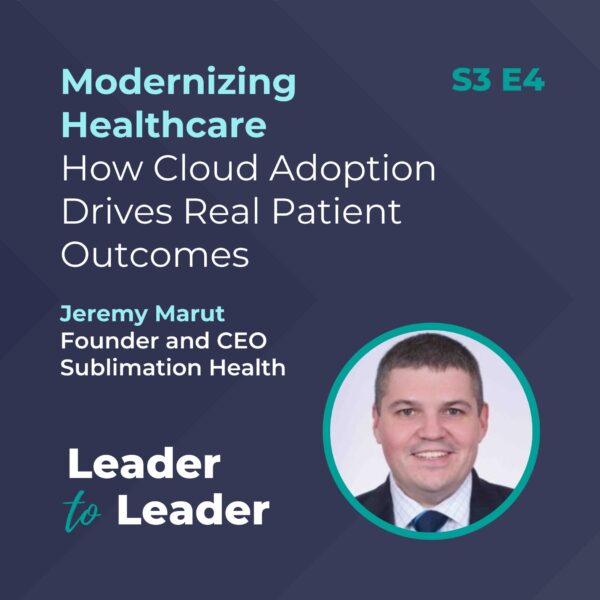
Modernizing Healthcare: How Cloud Adoption Drives Real Patient Outcomes
Healthcare cloud innovator Jeremy Marut has made it his life's mission to 'Save Lives, Not Drives.' In this episode of Leader to Leader, Jeremy talks about his company, Sublimation Health, and his commitment to help healthcare organizations get out of the data center business, so they can focus IT resources on lifesaving innovations.
Follow and subscribe on



Listen to the Podcast
Overview
Cloud adoption in healthcare is no longer a question of if, but how. For leaders navigating this transformation, the real challenge is in aligning technology with organizational purpose, trust, and long-term impact.
In this episode, Jeremy Marut, Founder and CEO of Sublimation Health, shares how his decades of experience in hospital IT led him to build a company that helps health systems shift from managing infrastructure to delivering meaningful solutions. He explores what it takes to overcome fear and uncertainty around cloud migration, why cost transparency matters, and how to reframe technical debt as an opportunity for reinvention.
In this episode, you’ll learn:
- Why Jeremy Marut is focused on helping health systems escape the burden of technical debt
- The biggest misconceptions about cloud migration in healthcare and how to overcome them
- How cost transparency, job security, and organizational alignment shape successful cloud transitions
- How Stoicism and servant leadership guide Jeremy’s decision-making as a founder and CEO
Our Guest
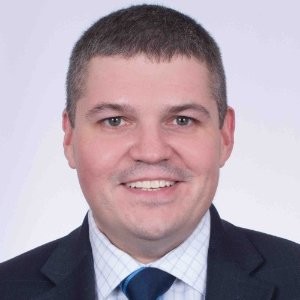
Jeremy Marut
Jeremy Marut is founder of Sublimation Health, supporting leading healthcare organizations at every step of their cloud adoption journey. Previously, Jeremy was Chief of Digital Modernization at Tufts Medicine, where he led the world’s first fully zero-on-premises Epic implementation—alongside its entire integrated third-party ecosystem—within the Amazon Web Services (AWS) public cloud. He has also led large IT and infrastructure teams at Rush University System for Health and Hackensack University Medical Center.
Jeremy is a CHIME certified CHCIO, and holds an MBA in technology management from the New Jersey Institute of Technology.
Transcript
This transcript has been generated by AI and optimized by a human.
Jeremy Marut (00:00): I started the company to get health systems out of the data center business, but also we want to be part of that solutioning. We want to be part of, okay, jump on that bandwagon but in a meaningful way
Narrator (00:15): From healthcare IT leaders. You’re listening to Leader to Leader with Paul Cannon, substituting for Ben Hilmes. Our guest today is Jeremy Marut, founder and CEO of Sublimation Health with more than two decades in healthcare IT, Jeremy shares why he left the hospital world to build a company focused on helping health systems move to the cloud and how meaningful cloud adoption goes far beyond technology. Jeremy also touches upon leadership stoicism and what it takes to drive change in an industry that’s often slow to evolve.
Paul Cannon (00:49): Jeremy, welcome to the Leader to leader. I think our discussion today is going to be really helpful for our listeners because so many are just starting their cloud journey, moving some or most of their application to the cloud. So with that I’d like to get into some of the questions. Take us back to the beginning. What problem in healthcare were you seeing that led to the creation of Sublimation Health?
Jeremy Marut (01:10): Oh, thanks for having me Paul. I agree. Right now the cloud itself is climbing up the priority list for most CIOs and CTOs out there. Take it back to the beginning. Boy, in my beginning every year it’s getting further away. I was on the healthcare health system IT side for 25 years. In that 25 years I had the pleasure of holding pretty much any role that you can name in healthcare IT over those 25 years. I think the biggest thing that turned me to create this company were Thanksgiving dinners out of my truck and vacations spent in the bathroom trying to hide from my family while I was on the phone trying to fix problems that were just part of the nature of healthcare. It’s just sometimes impossible to just keep ahead of all the technology that’s coming out, especially as your team is growing smaller and smaller.
(02:08):
I don’t think that any team has ever fully finished an implementation may have done okay, we got it in just enough. This functionality works enough to get us to the next one and we kick the can down the road and we just never go back. We never go back to finish. We never go back to ad features. We never go back to actually update and keep modern all of these hundreds of systems. We have maybe your EHR that gets all the love and attention. There are some organizations that can’t even keep up with that because of everything that’s coming out in my heart, the thing that brought me joy in all those 25 years was actually creating solutions that aligned with helping patients, helping physicians, helping the community, a developer by training and being able to cobble together various applications and workflows and things that we already owned rather than going out and buying the next package or the next suite actually having a purpose rather than making sure that drive doesn’t run out of space or that we can’t connect to an older server. So really helping health systems align their IT to bring a value to their core mission rather than actually building bigger and bigger and bigger technical debt that we can never get out of. That was the impetus for me to create sublimation health and actually help health systems get back into creating solutions rather than just keeping the lights on.
Paul Cannon (03:46):
Yeah, it’s funny you mentioned the drives in that part of the section. Our careers seem to have somewhat parallel in a little bit and the fact that we’ve both been in the healthcare field in 25 plus years and it really never left. So I certainly resonate with a lot of the things that you were saying about family time, et cetera. I love that company tagline, saving drives and getting back into the business of saving lives. What does that mean to you personally?
Jeremy Marut (04:12):
Well, first of all, I’m lucky that the words are catchy.
(04:15):
Save lives not drives. It all goes back to we’re in the business of healthcare where we want to save lives and we want to prolong lives. Meanwhile, the work that health system IT departments are doing are saving drives. So it works there, but the real reason behind it is a real mission, purpose and drive for people. For me personally, it was every single person in my family, including myself. Whenever we touch the healthcare system, it’s a nasty disgusting disaster from even finding information to doing that schedule to getting through your procedure and then the aftercare Along that line, you would say in 2025 with all the technology we have, all the advancements that have come, the experience is just still horrible. After our success in that first cloud implementation, I felt that we can have a big impact to help these organizations get people back to building solutions and give us the junk, give us the crap, let us worry about all those drives and everything that’s going down around you and all the technical debt that you’ve built up.
(05:33):
And actually, again, big circle back to what I said before, go back to creating solutions that make a difference. I could have gone and worked for Deloitte or KPMG or gone into finance or whatever. I really could have had my pick, and that’s not bragging, that’s just the fact. But I chose to stay in healthcare because of all this and because of how my mother couldn’t get an appointment, how my mother-in-law had my mother-in-law, my father-in-law and my mother all just went through cancer in the last three years. All three of ’em, thank God they’re alive. But that’s because I and friends have a Rolodex of surgeons and physicians in my pocket and even for me, it’s hard to get them the right level of service and experience. So imagine the entire rest of the country who doesn’t have that advantage. It’s a disaster for them. So it is a real deep passion and I feel that I have the tools, not as a surgeon or as a nurse, but as somebody that does solutions and understands technology to really have an impact on how a health system can make that experience better and ultimately save lives with
Paul Cannon (06:43):
Patients. That’s such a great story that resonates certainly with me. I came from a place where our company motto was healthcare is too important to stay the same, and we really kind of lived by that mantra, especially from an IT side. So I’m on the IT side. I have a younger sister who’s a surgical nurse that worked at MD Anderson and the stories that she would come back with and man, you talk about powerful and I’m thinking and I meet with ‘EM all the time just like you do. That Rolodex that you talked about, how do you navigate that system as I’ve got elderly folks now that live out of state from where I live, how do you help them navigate that system? I can’t imagine going through the cancer side. So at least fortunate enough to hear that your family’s on the up and option. That’s great news. Thank you. Next question. I hear this one a lot. So the cloud has moved past really the buzzword phase. It’s here, everybody knows its advantages, but there are still many health systems that are hesitant to move to the cloud. What would you say is the biggest misconception about the cloud migration in healthcare today?
Jeremy Marut (07:54):
I’m glad you brought up the buzzwords, and I do agree. I don’t think cloud is big a buzzword as AI because it’s real and there have been successes and I’m proud of that. There’ve been some failures too, but there’s been a majority of successes and it’s still very early. So when we talk cloud, it’s not like a concept or something that we’re making up any longer because there are hundreds of applications, especially the big ones that have successfully moved over and it’s been a success. The hesitation still really comes down to fud, fear, uncertainty and doubt. On the fear side, it’s still relatively new CIOs. They’re a big deal in their role. They’re, they’ve got a ton of responsibility, they have very important jobs, and making a decision like this to take your entire infrastructure a part of it and put it up into the public cloud is very scary.
(08:59):
They’re fearful. A lot of times we run into CIOs who will delegate it to the technical staff like the CTOs. But for us, our philosophy is we follow Epic for a lot of their philosophy is that it can’t be, not only is it not, but it can’t be an IT project. It’s a whole organization project. It’s a massive wholesale change if you’ve got the right partner. It doesn’t have to be a very disruptive change, but the fear is there that it will be disruptive. You’ve got fear from staff. Staff are very worried that they’re going to lose jobs. Where our philosophy and our mission, as we said in why we created the company was to not get rid of jobs, but to make them, I don’t want to say more meaningful because that’s not good for people. I mean their jobs are meaningful, but more aligned to the mission of the organization in developing solutions rather than standing up a server and naming it and upgrading things, let’s actually sit down and create a solution that a technology or a third party isn’t going to necessarily be able to do.
(10:13):
Put in video rounding for your patients. That’s not something that the cloud itself is going to do. Those are things that require development and solutions. So we try to help those fears, the uncertainty, so many different uncertainties. How do we handle the transition from CapEx to opex? So trying to understand how that model and how budgeting changes. How do you explain the benefits to your executive leadership? How do you not make it an IT project? That’s very difficult for a lot of folks. It’s still difficult for us when we’re asked. We constantly evolve based on our experience and what we’ve seen to help advise CIOs to talk to their CFOs and their leadership. But we also go in front of the board and explain what does this mean and how actually is it more secure? Uncertainty around costs, that’s a huge one. Everybody is extremely worried of the stories they’ve heard, which is a result of the methods some organizations are using to migrate to the cloud.
(11:24):
But how do we make sure our costs don’t go out of control for sublimation health? We go into it from day one with optimization in mind. We also do some innovative cost control measures in that we are so confident in our methodology and what it costs that we will go in with our services if we’re the managed service and we’ll cap those costs. Not only will we cap those costs, but when we work to bring those costs down, we also have a at-risk model where we will share that savings. So we try to quell that uncertainty and that worry. My conversations
Paul Cannon (12:01):
With the CIOs that I’ve had around the cloud stuff, there definitely seems to be that confusion and to your point, like misinformation. One of the things that I’ve universally heard is, is there savings or not? But the biggest piece that clients love is about the price transparency that they get when moving to the cloud. So I think that presumptions of savings, it can look different for each client. I’m sure you have experience with all that. Can you give us some scenarios where health systems can reduce those costs? What would you say the best examples of those are for in
Jeremy Marut (12:35):
Absolutely not just cloud to cloud, but app to app. One of the big differences in healthcare IT landscape is there are hundreds of vendors. None of them incentivized to be cloud native, so you’re talking commercial off the shelf software cos applications that have no incentive to go to the cloud. Many of them offer SaaS models, but there are hundreds or exponentially more that are small little applications that all have to interact to create that experience for the caregiver and the patient. So explaining savings from cloud on the easier side, there’s hard and soft savings, the hard savings that you can put in a spreadsheet. Cost avoidance. I don’t have to buy all this hardware. I don’t have to buy five times the amount of storage that I need and just have it sitting there dormant. The servers are as they’re on, not when they’re dormant and as long as you build that automation around it, you could take advantage of that.
(13:47):
But not only those applications are completely independent of each other. One application can be installed, used, highly available, backed up completely differently from hospital to hospital. So when I was bright-eyed and bushy tailed happy first started the company, everything we already did 40, 50, 300 of these apps, it’s going to be cakewalk to the next one. I have templates and then you get to the next one who has the exact same piece of software, but they use it entirely differently. So first and foremost, going into it with that optimized mindset from the beginning, it’s a mindset. We’re not just lifting this up and moving it all that does. The way I like to say it is you are refinancing that technical debt. We don’t want to refinance, we want to bite the bullet. We want to bankrupt ourselves without going out of business, but we have to wipe that debt out and we have to start with this great clean slate here that gives us that opportunity to modernize and then put in a tunnel of automation that you’ll never get back in that hole.
(15:00):
The public clouds for the first time ever in the last couple of years, that whole notion and concept of it is commoditizing is real. When the newer chip sets come out, the density of what it can handle goes up, the cost comes down. For the first time ever, and I saw this when we implemented Epic in AWS, and then I sat down with a hardware vendor who had given us a quote two years ahead, I wanted to check our ROI numbers. First time in 20 years, a vendor comes back to me and says, oh, you know that thing called Moore’s Law? Well, our prices have come down in the last three years. Never in my life have I seen less than an 18% increase over those 3, 4, 7 year cycles of refresh. So being able to take advantage of that, but it’s still difficult to put it in a spreadsheet the way A CFO likes to see, and a lot of the stronger cases are around those soft savings. What’s coming
Paul Cannon (16:06):
Next in healthcare cloud space? What should a CIO be thinking about in the next two to three
Jeremy Marut (16:12):
Years? Number one, the next two to three years having all of your data in that same place, but we’re multi-cloud naturally because there are so many cloud and so many SaaS, but at least it’s out there somewhere where you can connect to and teach, but the workflows are just as important.
(16:31):
Just having the data means absolutely nothing. So being able to learn on how you use the applications themselves, how those apps use the data, and how the clinicians and the patient reacts to the data that’s provided them, that’s what’s going to be tremendously empowering with the cloud in the very short future. I mean three years, I think even two years is so far to look forward because of all the stuff that’s happening now. I don’t want to get all philosophical about quantum computing, but again, getting into the cloud was so awesome and important. Those cloud providers, they’re going to have the quantum computers. They have the endless capacity for you to do what you need to do, and you’re not going to have to worry about doing all that research of, am I going with EMC? Am I going with hp?
(17:23):
What is quantum computing? The cloud providers provide, those technologies have heavily very lucrative incentives, right? They’ve got a heavy incentive for you to join like Amazon Health Lake. They want your data in there and they want use cases. They’re actually going to provide you geniuses, engineers, and dollars to actually create those solutions. That’s what Sublimation Health is really looking to get into. I didn’t start this company to migrate servers, by the way. I started the company to get health systems out of the data center business, but also we want to be part of that solutioning. We want to be part of, okay, jump on that bandwagon, but in a meaningful way. I always hated a proof of concept to nowhere, but we want to make things that are actually meaningful for an organization, for a specific patient, and the cloud has enabled that.
Paul Cannon (18:17):
We always close the show with some thoughts on leadership, and one of the things we’ve learned from you is that you’re super passionate about where you do, but anyone that knows you, that knows your stoicism is your guide to decision making. Tell us more about your thoughts on leadership and that philosophy.
Jeremy Marut (18:32):
Yeah, certainly. I’m constantly changing, dude. I have to adapt. It’s funny, I make reference to the version of myself today. I’m in 62.57, seven point 69 version of Jeremy. Just because you have to, you’ve got to learn, you’ve got to take input, you’ve got to take criticism, you’ve got to fail. Like Derek Jeter says, you’re always going to fail, but you need to take that head on and almost like an AI model. You’ve got to learn from it and adapt. I use the stoics and stoicism as a guide, but I always love stoicism because they’re very profound guidelines. Actually, in preparing for this interview and a good wrap up for this, I actually noticed something stoics are about self-reflection and aligned with. I always saw myself as a servant leader. I’m serving to everybody above me and below me and to the sides and everybody.
(19:26):
I’m here to help, but I need something to help me with. Give me the permission to celebrate, right? And it is very important being a CEO and a founder of a startup that’s now growing tremendously, the tremendous growth part, find I can’t take a moment to celebrate a win and some big wins too. I’m like, okay, what’s the next one I’m worried about? Okay, did we get this one that isn’t so good for your team? So that hopefully version 63.99 B, we’ll have Jeremy throwing a party and I’ll invite you. We’ll have some champagne and stuff, but that’s the next thing that I’m really trying to work on to really celebrate what we’ve done and where we’ve come in. Just two years really has been tremendous, and if Jeremy of last year we talked to Jeremy of this year, he’d probably slap me in the face and tell me, shut the hell up, man. Look at what the heck, what’s going on here? So we’ll get there though. It’s been horrendous.
Paul Cannon (20:20):
We definitely need you to take that time and pause the celebration. You guys at Sublimation Health certainly earned it. You got a lot to be proud of with your point in that short amount of time. So love talking to you. Really appreciate the insight to what you have going on, and we really need people like you in healthcare and N it because Save the Chef later. Do that one as well. Appreciate your time today.
(20:46):
Jeremy, co-founder and CEO of Sublimation Health shared his experience in healthcare IT and cloud transformation. Here are three main points from our discussion. First, Jeremy’s goal is to help health systems move from old technology to new solutions that improve patient care and save lives. Second, moving to the cloud is a big change. It takes trust and openness to overcome, worries about cost disruption and job security. Third, Jeremy envisions a future of healthcare as cloud-based innovation that leverages artificial intelligence to enhance workflows and patient outcomes. He also advises leaders to stay flexible and keep a calm and steady mindset. What do you think of Jeremy’s story? Let us know on social or email us@healthcareitleaders.com.
Narrator (21:43):
Thanks for joining us for Leader to Leader. To learn more about how to fuel your own personal leadership journey through the healthcare industry, visit healthcare it leaders.com. Don’t forget to subscribe so you don’t miss any insights, and we’ll see you on the next episode.